
Keeping Moore County Cats Happy, and Healthy, Indoors
By Anna Vermeulen
How keeping cats safely contained protects our pets, wildlife, and communities
As a cat owner, and as cat owners ourselves, we always want the very best for our feline family members. We’re always looking for the best food, toys, and more for our cats. And, as loving cat owners, we often want to provide our fur-family with the freedoms of the outdoors. But is actually the best choice for the kitties within our care?
Regrettably, the road to folly is often paved with good intent. In pursuit of providing the best for our feline friends, cat owners often fall into the farce that “they belong outdoors”. But is actually the best choice for the kitties within our care? Let’s explore the ins and outs of what the life of an outdoor cat, or indoor-outdoor cat, actually entails.
“Keeping cats safely indoors is an act of love — for them, and for everything that shares their world.”
Outdoor Cats and Wildlife Don’t Mix
Cats are highly adept hunters. Across the U.S., free-roaming domestic cats kill an estimated 1.4–3.7 billion birds and 6.9–20.7 billion mammals every year.
Even well-fed cats retain their natural hunting drive, and this takes a heavy toll on wildlife.
Globally, domestic and feral cats have heavily contributed to the extinction of at least 63 bird, mammal, and reptile species. One famous case, the Stephens Island Wren, vanished entirely after cats were introduced to its small island home.
These aren’t isolated incidents — they’re quiet but powerful disruptions to ecosystems that depend on balance. At PetWise Professionals, we believe protecting cats also means protecting the world around them. 😼🙅♀️🐦⬛
Hidden Dangers for Outdoor Cats
Life outside carries far more risk than freedom.
Common hazards include:
- Vehicle strikes: Among the leading causes of death for outdoor cats.
- Predation: Hawks, owls, coyotes, and foxes see outdoor cats as prey.
- Injury or poisoning: From fights, traps, or toxic substances such as ice melt, rat poison, poisonous foods in garbage bins, and engine oil in puddles.
- Parasites and disease: Fleas, ticks, parasitic worms, and communicable diseases among other cats, are often contracted outdoors.
“Even the savviest cat can’t outsmart a speeding car or a hungry coyote.”
The Health and Safety Costs of Outdoor Life
Cats that roam are also more likely to spread or contract diseases, including:
- Toxoplasma gondii, a parasite shed in feces that can harm wildlife and human health.
- Feline Immunodeficiency Virus (FIV) and Feline Leukemia Virus (FeLV), which spread through bites and mating.
By keeping cats indoors—or in safe, enclosed spaces—we help protect their health and the health of the community.

Hidden Dangers for Outdoor Cats
Life outside carries far more risk than freedom.
Common hazards include:
- Vehicle strikes: Among the leading causes of death for outdoor cats.
- Predation: Hawks, owls, coyotes, and foxes see outdoor cats as prey.
- Injury or poisoning: From fights, traps, or toxic substances such as ice melt, rat poison, poisonous foods in garbage bins, and engine oil in puddles.
- Parasites and disease: Fleas, ticks, parasitic worms, and communicable diseases among other cats, are often contracted outdoors.
“Even the savviest cat can’t outsmart a speeding car or a hungry coyote.”
Unintended Consequences: The Overpopulation Problem
Even short outdoor adventures can lead to unplanned litters.
Unaltered (unfixed) cats roam farther, fight more, and reproduce rapidly, creating strain on local shelters and rescue organizations.
Spaying and neutering not only prevent unwanted kittens but also promote calmer, healthier, and longer-lived pets.
PetWise Takeaway: cats commonly produce up to three litters a year, but up to four, with an average of five kittens per litter. The average unfixed cat is estimated to contribute between 100-180 kittens in her lifetime. And that’s just from ONE cat 🤯.
When “Indoor/Outdoor” Isn’t Quite Safe Enough
Cats face a myriad of risks when roaming, even negating weather. And when winter rolls in, so do additional challenges. Some families allow cats to come indoors for meals or shelter, and while that’s safer than leaving them entirely outdoors, it still carries risks — especially in harsh weather.
Each year, cats suffer or perish from exposure to freezing temperatures, dehydration, and frostbite.
If a cat spends any time outside, ensure it has:
- Insulated, windproof shelter (reminder –
- Access to fresh, unfrozen water (heated bowls available)
- Ample food and bedding
PetWise Takeaway: When temperatures plummet, cats and wildlife often seek shelter in potentially hazardous environments, such as car engines which can lead to grizzly outcomes when a car is started and heats up.
“When the temperature drops, no cat should be left to fend for itself.”
Safer Outdoor Freedom: The Best of Both Worlds
For cat owners who want to offer safe outdoor time, there are excellent alternatives:
Catio Enclosures
Screened patios or enclosed play spaces that let cats climb, nap, and explore — safely.
🐈⬛ Leash & Harness Training
Yup. It’s a thing. With patience, many cats actually enjoy supervised walks or yard time. Just make sure you’re getting a cat specific harness, not a collar, with a bungee leash to reduce and pull for excitable felines.
🧱 Cat-Proof Fencing
Want to be the cool cat in town? Modern fencing systems, featuring rolling or angled top rails that gently pivot if a cat tries to climb, keep your cat safely inside their yard while providing that “great outdoors” feeling.
PetWise Bonus Points: This fencing system also helps keep other cats, and those pesky squirrels, out of your yard too. Which is a double win, as it aids in further protecting your feline from contact-based communicable diseases.
🦅 Anti-Predation Collars
Brightly colored collars (like Birdsbesafe®) and bib-style attachments have been shown to dramatically reduce bird and small mammal predation. Always ensure your cat is wearing a break-away collar, to prevent unintended strangulation.
🧩 Indoor Enrichment
Still looking for a way to enrich your cat’s life? Good! Enrichment is the missing puzzle piece to providing the mental stimulation your cat needs, in the safety of home.
Window hammocks positioned by bird feeders, cat towers & vertical shelving, puzzle feeders, and regular play keep cats happy, stimulated, and active — no outdoors required.
“Enrichment and safety can live side by side.”
Supporting Moore Feral Cats: TNR Programs
Not all cats have homes, but that doesn’t mean they should be forgotten.
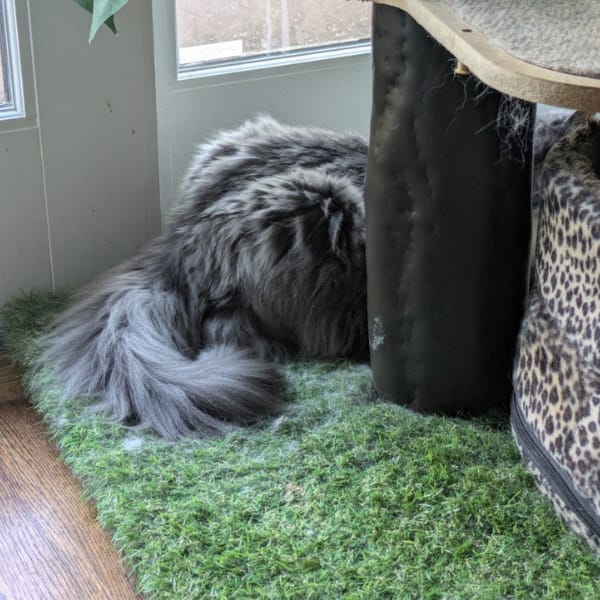
Our team proudly supports local Trap–Neuter–Return (TNR) programs — humane initiatives that trap unowned or feral cats, provide spay/neuter and vaccinations, and return them to their colonies.
TNR helps stabilize feral populations, reduce suffering, and minimize environmental impact — an approach rooted in both compassion and community care.
“Through TNR partnerships, we’re helping reduce suffering while respecting the lives of cats already born outdoors.”
PetWise Professionals is committed to compassion, and dedicated to care. Learn more about our community TNR efforts → HERE
A Compassionate Conclusion💜
Keeping cats safely contained protects:
- Your cat, from disease, predators, and injury.
- Wildlife, from preventable harm and extinction.
- Communities, from the spread of parasites and overpopulation.
Every choice to keep a cat safe inside is a choice for kindness — to the pet you love, and to the delicate world beyond your window.
Love them enough to keep them safe.💜🐾